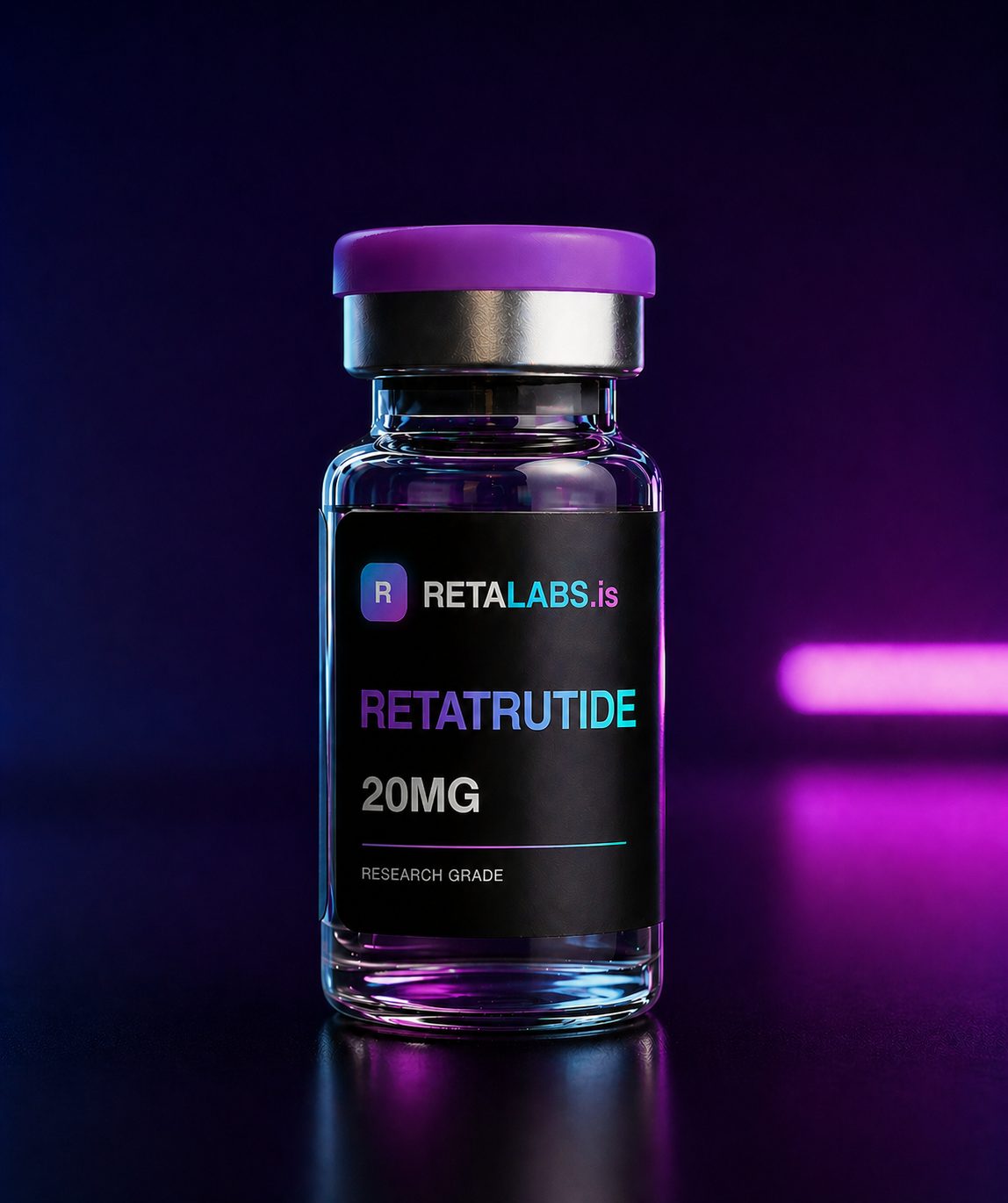
Product images are for illustration purposes only. Actual packaging and labelling may vary.
Retatrutide 20mg
20mg
Retatrutide is a next-generation triple agonist peptide targeting GLP-1, GIP, and glucagon receptors simultaneously, making it the most advanced metabolic research compound available. Studies have demonstrated superior weight reduction outcomes compared to dual-agonist peptides, with research subjects showing significant reductions in body fat, improved insulin sensitivity, and favourable changes in lipid profiles. This 20mg vial offers researchers a high-purity supply for extended study protocols. COA-backed with HPLC purity data. Lyophilised powder, requires reconstitution with bacteriostatic water.
Crypto payments only , How to pay guide
Research Use Only: For laboratory research purposes only. Not for human or animal consumption.
Documentation
COA-backed
Source
Manufacturer COA
Shipping
Australia-wide
Payment
Crypto only
Litecoin (LTC) is the easiest to send: low fees, fast confirmation.
We lock your price for 30 minutes, so the amount you see will not change while you pay.
- Pick a coin. Litecoin (LTC) is the easiest for most buyers.
- Send the exact amount we show. Tap to copy it, do not type it.
- We confirm on-chain automatically, usually in 2-5 minutes, then ship your order.
Australia-wide dispatch
Australia Post Express tracked · 1–2 business days
Research-grade · COA-verified
HPLC purity data · manufacturer CoA
Crypto payment
BTC · LTC · XMR · researcher privacy by design
Batch & testing
- Current batch
- RETA20-2608-01
- HPLC purity
- 99.73%
- Test date
- 2 August 2026
- Source
- Manufacturer Certificate of Analysis
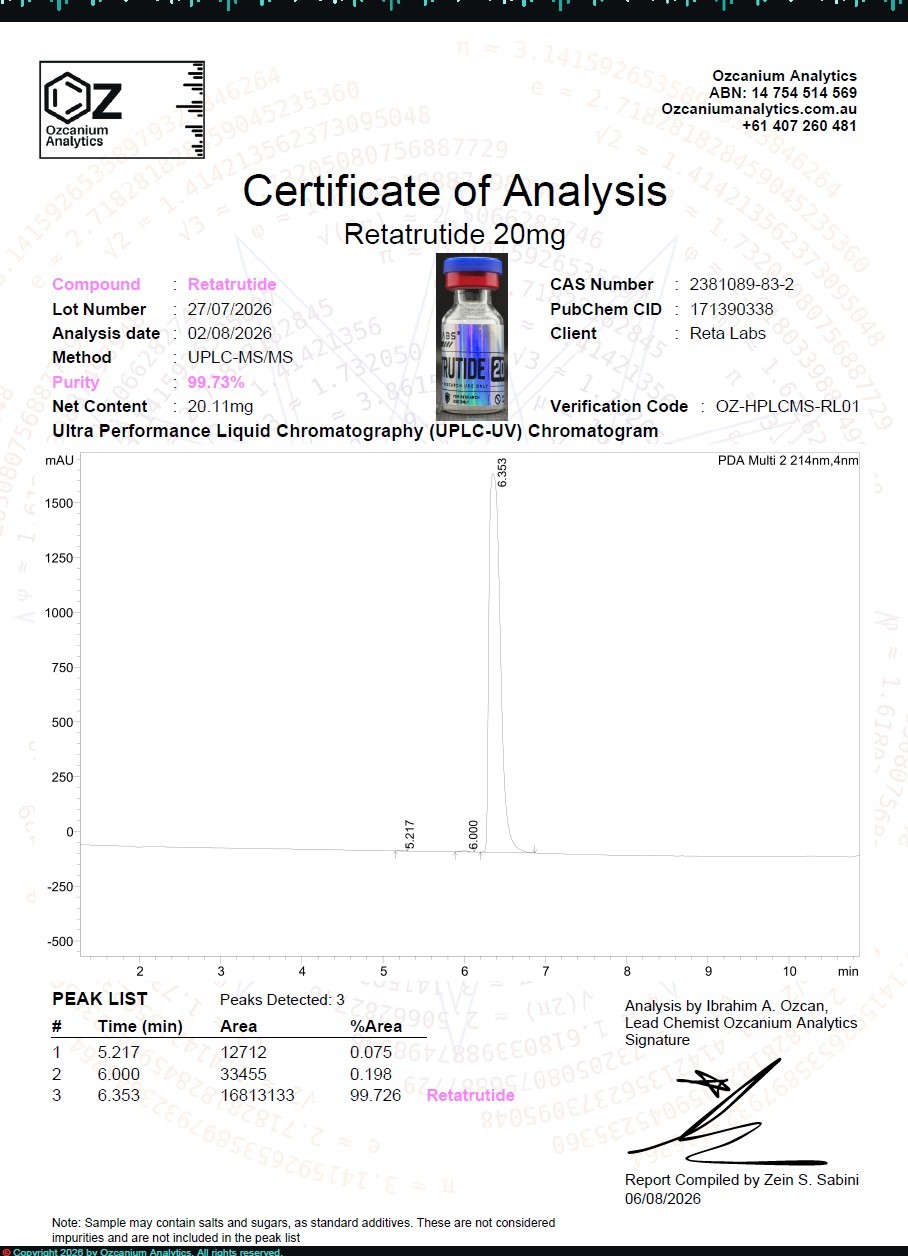
The current batch's manufacturer Certificate of Analysis, identifying details redacted to protect our supply chain.
RetaLABS Retatrutide 20mg is a lyophilised research vial of LY3437943, a triple GLP-1, GIP, and Glucagon receptor agonist developed by Eli Lilly. At the 4mg/week starting dose used in Phase 2 cohorts, a single 20mg vial supplies five weeks of research. At the 8mg/week maintenance dose, it covers approximately 2.5 weeks of protocol. The 20mg format is the most common choice for Australian researchers running short-to-medium-duration Phase 2-style cohorts; researchers planning long maintenance protocols typically prefer the 30mg vial for fewer reconstitution events.
Supplied as a white lyophilised powder. Shipped via Express Post Australia-wide in discrete, unmarked packaging, typically dispatched within 1–2 business days of confirmed crypto payment (BTC, LTC, or XMR).
Also available as Retatrutide 10mg for lower-dose titration protocols, and Retatrutide 30mg for extended-duration or higher-dose cohorts.
Why Retatrutide Is Mechanistically Distinct
Retatrutide is the first triple receptor agonist in human clinical trials in the GLP-1 class. The compound simultaneously activates three receptors that have historically been engaged separately or in pairs:
- GLP-1R (Glucagon-Like Peptide-1 Receptor). Drives glucose-dependent insulin secretion, suppresses glucagon, slows gastric emptying, and signals satiety via hypothalamic and brainstem pathways. This is the receptor engaged by Semaglutide and the GLP-1 component of Tirzepatide.
- GIPR (Glucose-dependent Insulinotropic Polypeptide Receptor). Amplifies beta-cell insulin secretion through pathways distinct from GLP-1R, modulates adipose tissue lipid handling, and appears to reduce the GI adverse-event burden associated with isolated GLP-1R agonism. This is the second receptor engaged by Tirzepatide (the "twincretin" target).
- GcgR (Glucagon Receptor). The third receptor, unique to Retatrutide among the three primary research-grade GLP-1 class peptides. GcgR agonism drives hepatic fatty acid oxidation and thermogenesis, adding an energy-expenditure mechanism on top of the appetite-suppression and insulin-secretion mechanisms of GLP-1R/GIPR.
For the full mechanism explainer including how GcgR's glucose-raising effect is offset by GLP-1R co-agonism, see the Glucagon Receptor Explained entity page. For the GLP-1 entity overview see GLP-1 Explained.
Phase 2 Trial Data, What Researchers Are Working From
The pivotal Phase 2 trial (Jastreboff et al., NEJM 2023, NCT04881760) enrolled 338 adults across six cohorts over 48 weeks. Top-line outcomes at the 48-week primary endpoint, by dose:
| Dose cohort | Mean weight loss | Placebo-adjusted |
|---|---|---|
| Placebo | 2.1% | - |
| 1mg/week | 8.7% | ~6.6% |
| 4mg/week (fast titration) | 17.3% | ~15.2% |
| 8mg/week | 22.8% | ~20.7% |
| 12mg/week | 24.2% | ~22.1% |
Secondary endpoint magnitudes at the 12mg cohort: approximately 41% mean reduction in fasting insulin; approximately 43% mean reduction in triglycerides; approximately 18.5 cm mean reduction in waist circumference; meaningful reduction in liver fat fraction on MRI in the measured subset. Cardiometabolic biomarkers including HbA1c, LDL cholesterol, and blood pressure also improved across active cohorts.
The 20mg vial covers the early cohort durations of every Phase 2 escalation schedule. At the 4mg/week dose level (Phase 2 starting maintenance dose for the lower cohorts), a single 20mg vial supplies five weekly doses. The 8mg/week cohort uses one 20mg vial across approximately 2.5 weeks; the 12mg/week cohort consumes a 20mg vial in approximately 1.7 weeks at full maintenance dose. Researchers running longer maintenance phases at peak doses generally combine 20mg and 30mg vial purchases or rely on the 30mg format alone.
For the full Phase 2 statistics including adverse event rates, discontinuation breakdown, and cohort-by-cohort numbers, see the Retatrutide Statistics 2026 data page.
Cross-Compound Comparison
Retatrutide research is most usefully contextualised against the two other compounds in the GLP-1 receptor agonist class with the strongest published trial data. The following table is cross-trial (drawn from separate studies with different populations, durations, and dose designs, not a head-to-head trial) so direct ranking requires caution:
| Metric | Semaglutide | Tirzepatide | Retatrutide |
|---|---|---|---|
| Receptor targets | GLP-1R | GLP-1R + GIPR | GLP-1R + GIPR + GcgR |
| Compound class | Single | Dual (twincretin) | Triple agonist |
| Developer | Novo Nordisk | Eli Lilly | Eli Lilly |
| Pivotal trial | STEP 1, 68 weeks | SURMOUNT-1, 72 weeks | Phase 2, 48 weeks |
| Trial enrolment | 1,961 | 2,539 | 338 |
| Highest dose | 2.4mg/week | 15mg/week | 12mg/week |
| Mean weight loss (highest dose) | 14.9% | 20.9% | 24.2% |
| Half-life | ~7 days | ~5 days | ~6 days |
| Phase 3 status | Complete | Complete | TRIUMPH ongoing |
For full side-by-side comparisons see Retatrutide vs Tirzepatide and Retatrutide vs Semaglutide.
Reconstitution at a Glance
The most common research-protocol approach for a 20mg vial: add 2.0mL bacteriostatic water to produce a 10mg/mL working concentration. At this concentration, individual dose volumes on a standard U100 insulin syringe are:
| Dose | Volume at 10mg/mL | U100 syringe units |
|---|---|---|
| 2 mg | 0.20 mL | 20 units |
| 4 mg | 0.40 mL | 40 units |
| 6 mg | 0.60 mL | 60 units |
| 8 mg | 0.80 mL | 80 units |
Reconstitution technique: inject the bacteriostatic water slowly down the inner wall of the vial, swirl gently (do not shake), and store the reconstituted solution refrigerated at 2–8°C. The bacteriostatic water diluent contains 0.9% benzyl alcohol as a preservative, supporting multiple withdrawals from the same vial across an approximately 4-week stability window. For full protocol detail see the Peptide Reconstitution & Storage Guide and the reconstitution calculator.
Sourcing, Quality & Documentation
RetaLABS Retatrutide is supplied as research-grade, manufacturer-verified lyophilised peptide. Each batch is purity-tested by HPLC. Where a batch is published, its Certificate of Analysis appears on this page.
All Retatrutide vials are supplied for laboratory research use only. Retatrutide is not approved as a therapeutic in Australia (TGA register confirmed); it has not completed Phase 3 trials in any jurisdiction. By placing an order you confirm the compound is acquired for research purposes and not for human consumption. For the regulatory framework see Retatrutide Legal Status in Australia.
Primary Research References
The core peer-reviewed publications underlying current Retatrutide research:
- Jastreboff AM et al. "Triple-Hormone-Receptor Agonist Retatrutide for Obesity, A Phase 2 Trial." New England Journal of Medicine, 2023; 389:514-526. doi:10.1056/NEJMoa2301972. The pivotal Phase 2 dose-finding study. NCT04881760.
- Coskun T et al. "LY3437943, a novel triple glucagon, GIP, and GLP-1 receptor agonist for glycemic control and weight loss: From discovery to clinical proof of concept." Cell Metabolism, 2022; 34:1234-1247. doi:10.1016/j.cmet.2022.07.013. Original receptor-binding characterisation and Phase 1 pharmacokinetic profile.
- Rosenstock J et al. "Retatrutide, a GIP, GLP-1 and glucagon receptor agonist, for people with type 2 diabetes: a randomised, double-blind, placebo and active-controlled, parallel-group, phase 2 trial conducted in the USA." The Lancet, 2023; 402:529-544. doi:10.1016/S0140-6736(23)01053-X. Phase 2 trial in adults with type 2 diabetes.
- Sanyal AJ et al. "Triple Hormone Receptor Agonist Retatrutide for Metabolic Dysfunction-Associated Steatotic Liver Disease: a randomised, double-blind, placebo-controlled, phase 2a trial." Nature Medicine, 2024; 30:2037-2048. Phase 2a MASH/NAFLD trial. No Phase 3 MASH trial has been registered in the TRIUMPH programme as of 2026.
- ClinicalTrials.gov registrations: Phase 2 trial NCT04881760; Phase 3 TRIUMPH-1 NCT05929066, TRIUMPH-2 NCT05929079, TRIUMPH-3 NCT05882045, TRIUMPH-4 NCT05931367, TRIUMPH-Outcomes NCT06383390.
The RetaLABS Research Team's editorial and sourcing methodology is documented at the RetaLABS Research Team profile.
Related Research Reading
The full Retatrutide research cluster:
- Retatrutide Research Guide, full mechanism, trial data, reconstitution, sourcing
- Retatrutide Statistics 2026, quick-facts data block, cohort numbers, trial registry
- Phase 3 TRIUMPH Update, current trial status across the TRIUMPH programme
- Dosing Protocol Reference, Phase 2 escalation schedule + reconstitution maths
- Side Effects (Phase 2 Data), full AE profile and discontinuation breakdown
- Retatrutide vs Tirzepatide, triple vs dual agonist research comparison
- Retatrutide vs Semaglutide, triple agonist vs GLP-1 single-receptor comparison
Customer Reviews
Came through in good time.
Good comms, smooth Express Post.
Smooth from order to delivery.
Will buy again
Legit product. Fast delivery. No issues at all.
Pleased with how quick it came
No issues, arrived well
Super fast delivery
Product Specifications
Research-grade, manufacturer-verified
Lyophilised powder
~4.4 kDa
-20°C (lyophilised), 2-8°C (reconstituted)
Bacteriostatic water or sterile saline
39-residue triple agonist (GLP-1 / GIP / Glucagon) · Aib substitutions · C20 fatty-diacid acylation
Research Use Only: These products are intended for laboratory research use only and are not approved for human consumption. All purchases are subject to our terms of service and local regulations.
Frequently Asked Questions
Everything you need to know about Retatrutide 20mg
Research Guides
Retatrutide Molecular Profile: Formula, Weight, CAS Number, Sequence and Structure
8 min read
Retatrutide Australia 2026: Research Guide, Mechanism, Trial Data & Reconstitution
15 min read
Retatrutide 2026: Phase 3 Trials and What Researchers Should Know
17 min read
Retatrutide vs Tirzepatide: Triple vs Dual GLP-1 Agonism in Research
8 min read
Buying Research Peptides with Crypto in Australia: A Practical Guide
5 min read
Retatrutide Dosing Protocol: Phase 2 Trial Reference for Researchers
8 min read
GLP-1 and lean mass loss: what the clinical data actually shows: and why the receptor mechanism matters
16 min read
Why GLP-1 receptor agonists drive lean mass loss: the physiology behind the body composition data
11 min read
Drugs studied to preserve muscle on GLP-1s: bimagrumab, enobosarm, and the activin–myostatin approach
11 min read
Retatrutide Dosage Protocol Australia: Phase 2 Dosing Schedule & Escalation Guide
10 min read
Retatrutide Side Effects: Phase 2 Safety Data for Australian Researchers
8 min read
Retatrutide vs Semaglutide: Mechanism, Efficacy, and Research Comparison
8 min read
Retatrutide Cost Australia: Price Guide, Value Considerations & Sourcing
6 min read
Is Retatrutide Legal in Australia? TGA Status, Research Use & Sourcing
7 min read
Retatrutide vs Tirzepatide Australia: Triple vs Dual Agonist Research Comparison
8 min read
Retatrutide Statistics 2026: Trial Numbers, Dose-Cohort Data & Phase 3 Enrollment
13 min read
Retatrutide Research in Australia: 2026 Annual Report
14 min read
Retatrutide Research Papers: Primary Source Index 2026
8 min read
Retatrutide FAQ: 50 Research Questions Answered
18 min read
Retatrutide TRIUMPH-1 Results (2026): What the Phase 3 Data Showed
9 min read